
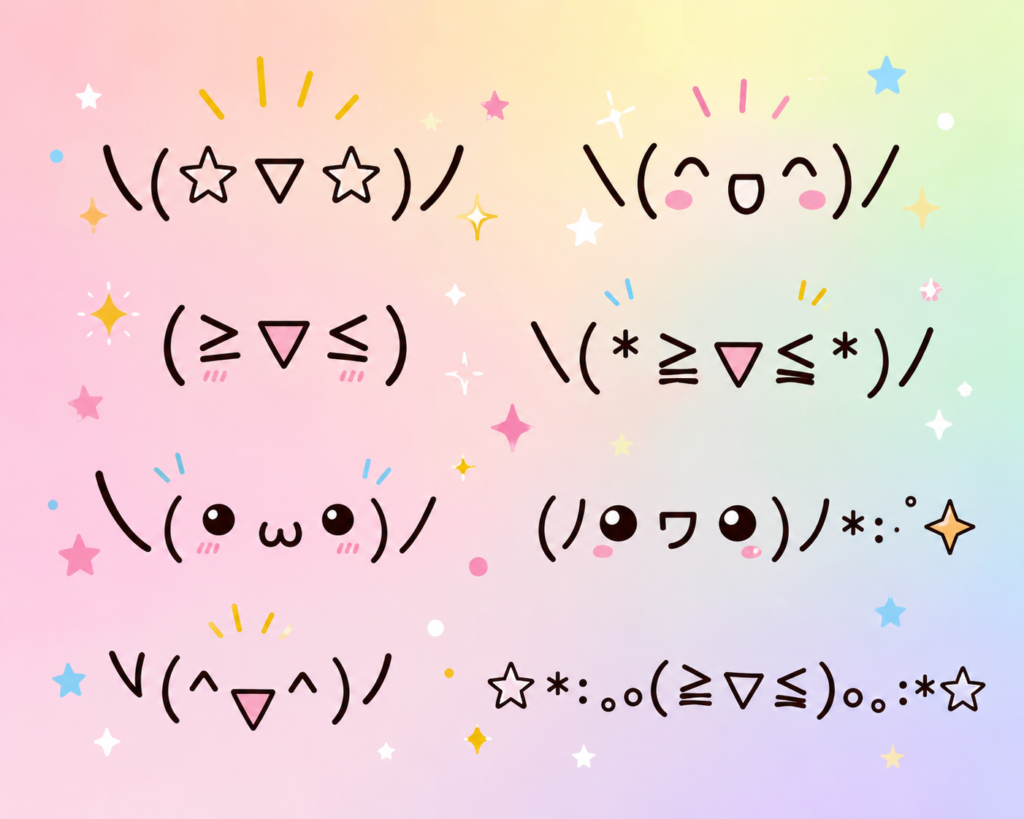
You know that feeling when a text pops up with good news and a plain “yay!” just doesn’t cut it? That’s usually when an excited kaomoji shows up to save the conversation. These little text-based faces — built entirely from letters, punctuation, and symbols — have a way of packing pure energy into a single line without a single actual emoji.
Excited kaomoji show up everywhere: group chats celebrating a friend’s promotion, Discord servers reacting to a clutch gaming win, Instagram captions announcing a trip, and comment sections hyped about a concert lineup. They’re expressive, a little chaotic in the best way, and instantly recognizable even if you’ve never typed one yourself.
This guide breaks down everything worth knowing about excited kaomoji — what they are, how to read them, dozens you can copy and paste right now, and how to build your own from scratch.
What Are Excited Kaomoji?
Kaomoji (顔文字, literally “face characters”) are emoticons built using standard keyboard characters, arranged so that the whole thing reads as a face — usually when you tilt your head slightly or just get used to the style. Unlike Western emoticons such as :) or :D, which are meant to be viewed sideways, kaomoji are designed to be read upright, which is why they can include full arms, hands, sweat drops, and sparkles around a central face.
The style originated in Japan in the late 1980s, growing out of early bulletin board culture where users experimented with ASCII art to add emotion to plain text. Over time, kaomoji evolved into a full visual language, with dedicated symbols for tears, blushing, anger, confusion, and — most relevant here — excitement.
An excited kaomoji typically features:
- Wide or sparkling eyes, like
★or>shapes - An open mouth, often a
o,O, or▽ - Raised arms or hands, shown with
/and\characters - Extra decoration such as sparkles (
✧,☆) or exclamation-style symbols
A few quick examples to illustrate the style:
\(≧▽≦)/(๑˃̵ᴗ˂̵)و\(^o^)/
Compare that to a plain text emoticon like :D, and it’s easy to see why kaomoji have stuck around. They carry more visual energy, they don’t rely on a single rotated symbol, and they can be endlessly customized to match a specific mood — mild enthusiasm, screaming excitement, or something cute and shy in between.
Kaomoji have stayed popular for a simple reason: they work everywhere. Since they’re made of standard text characters (not image-based emoji), they paste cleanly into almost any chat app, comment box, or caption field, regardless of platform or device.
Best Excited Kaomoji to Copy and Paste
Here’s a practical collection organized by mood, so you can quickly find the right level of energy for the moment.
Super Excited Kaomoji
\(★^O^★)/ヽ(>∀<☆)ノ\(^▽^@)ノ(ノ≧∀≦)ノ
Cute Excited Kaomoji
(๑>◡<๑)(≧◡≦)ヽ(*・ω・)ノ(*≧ω≦*)
Happy and Excited Kaomoji
(⌒▽⌒)☆\(^o^)/(≧∇≦)/ヽ(=^・ω・^=)丿
Extremely Excited Kaomoji
\(٥⁰△⁰٥)/ヽ(°〇°)ノ(ノ°ο°)ノ\(°ロ°)/
Excited Kaomoji With Sparkles
✧٩(ˊωˋ*)و✧(っ˘ω˘c)✧☆*:.。.o(≧▽≦)o.。.:*☆(っ´ωc)✧`
Excited Kaomoji for Texting
(^o^)/\(^_^)/(≧∀≦)\(^o^)/
Excited Kaomoji for Social Media
ヽ(´▽)/`(◕‿◕)✧\(≧▽≦)/(๑˃ᴗ˂)ﻭ
Every one of these is ready to paste directly into a message, caption, or comment — no extra formatting needed.
What Does an Excited Kaomoji Mean?
Excitement isn’t one single feeling, and excited kaomoji reflect that range. Depending on the specific face and the surrounding conversation, the same general style of kaomoji can express:
- Happiness — a warm, positive reaction to good news
- Anticipation — looking forward to something upcoming, like a trip or event
- Surprise — an unexpected but welcome twist
- Celebration — marking an achievement or milestone
- Enthusiasm — general high energy about a topic or plan
- Nervous excitement — a mix of excitement and jitters, often before something big
- Playful excitement — lighthearted teasing energy, common between friends
Context does a lot of the heavy lifting here. A kaomoji like \(★^O^★)/ sent after “I got the job!” clearly reads as celebration. The same kaomoji sent after “we’re getting pizza tonight” reads as lighter, more playful enthusiasm. The face doesn’t change — the meaning shifts based on what it’s responding to.
Excited Kaomoji vs. Happy Kaomoji
Excitement and happiness overlap, but they’re not identical, and kaomoji styles reflect that difference.
| Feature | Excited Kaomoji | Happy Kaomoji |
|---|---|---|
| Energy level | High, often with raised arms or motion | Calm, steady, content |
| Common symbols | Sparkles, wide-open mouths, exclamation energy | Soft eyes, gentle smiles |
| Typical use | Big news, celebrations, hype moments | General good mood, casual chats |
| Example | \(★^O^★)/ | (^▽^) |
| Movement implied | Often looks like jumping or waving | Usually static and relaxed |
In short: happy kaomoji say “I feel good,” while excited kaomoji say “I feel good and I can barely sit still about it.”
How to Use Excited Kaomoji in Text Messages
Seeing kaomoji in context makes it much easier to know when to use them. Here are a few realistic exchanges.
Good news: “I passed my exam!!” → \(^▽^)/ AMAZING, I knew you would!
An invitation: “Want to come to game night on Friday?” → ヽ(°〇°)ノ count me in!!
A birthday announcement: “It’s officially my birthday month 🎂” → \(≧▽≦)/ let's celebrate all month then!
A concert announcement: “They just announced tour dates near us!” → \(★^O^★)/ we HAVE to go
A new job: “Just accepted the offer!” → ヽ(=^・ω・^=)丿 so proud of you!!
A gaming achievement: “Finally beat that boss after 20 tries” → (ノ°ο°)ノ LET'S GOOO
A weekend plan: “Thinking beach day Saturday?” → (≧∇≦)/ yes yes yes
A surprise: “Guess who’s in town this weekend?” → \(°ロ°)/ WAIT WHAT
The pattern is simple: the bigger or more sudden the news, the more expressive the kaomoji can get.
Food-related plans are another spot where excited kaomoji show up constantly. If a friend texts about grabbing breakfast before work, a quick \(^o^)/ yes let's do it, but what time does starbucks stop serving breakfast? keeps the enthusiasm while actually asking something useful. The same goes for coffee-run conversations — someone hyped about a new drink order might text (≧◡≦) obsessed with this flavor, though now I'm curious about iced caffe latte starbucks calorie counts before I order another one. Little moments like these are exactly where kaomoji feel natural instead of forced.
Excited Kaomoji for Different Situations
Not every kind of excitement looks the same, and picking the right kaomoji for the setting makes messages feel more natural.
Friends
Casual, high-energy kaomoji work well here: \(^o^)/ or ヽ(*・ω・)ノ fit easily into everyday back-and-forth.
Family
Slightly warmer, softer options tend to land better: (⌒▽⌒)☆ or (≧◡≦) read as excited without being over the top.
Romantic Messages
Cute, gentle excitement suits romantic contexts best: (っ˘ω˘c)✧ or (◕‿◕)✧ add warmth without feeling chaotic.
Gaming
Big, dramatic reactions are the norm in gaming chats: ヽ(°〇°)ノ or \(°ロ°)/ match the intensity of a clutch win or big drop.
Discord
Discord culture rewards expressive, meme-friendly kaomoji: ✧٩(ˊωˋ*)و✧ or \(≧▽≦)/ fit right into server chatter.
Social Media
Captions and comments benefit from shorter, scannable kaomoji: (◕‿◕)✧ or ヽ(´▽)/` work well in limited caption space.
Online Communities
Forums and comment threads often favor slightly understated excitement: (≧∇≦)/ keeps things enthusiastic without dominating the thread.
Celebrations
Go big here — \(★^O^★)/ and ☆*:.。.o(≧▽≦)o.。.:*☆ are built for milestones.
Good News
Anything with sparkles or raised arms fits: ✧٩(ˊωˋ*)و✧.
Reactions to Surprises
Sharp, sudden-feeling kaomoji work best: \(°ロ°)/ mirrors that jaw-drop moment.
Cute Excited Kaomoji You Can Copy and Paste
For readers who just want a quick, cute grab-and-go list, here’s a larger set grouped for convenience.
Soft and sweet:
(๑>◡<๑)(≧◡≦)(っ˘ω˘c)
Bouncy and playful:
ヽ(*・ω・)ノ(*≧ω≦*)ヽ(=^・ω・^=)丿
Sparkly and celebratory:
✧٩(ˊωˋ*)و✧☆*:.。.o(≧▽≦)o.。.:*☆(っ´ωc)✧`
Big reaction energy:
\(≧▽≦)/\(★^O^★)/ヽ(°〇°)ノ
Save this section as a quick reference whenever you need something fast.
How to Make Your Own Excited Kaomoji
Once you understand the building blocks, creating a custom excited kaomoji is mostly a matter of mixing and matching parts:
- Eyes:
^ ^,≧ ≦,★ ★,° °,◕ ◕ - Mouth:
▽,o,O,∀,ω - Arms:
\( )/,ヽ( )ノ,\( )/ - Hands or gestures:
و,ノ,ノ - Decorative symbols:
✧,☆,*,.。.
Swapping just one piece can shift the entire feeling. For example:
(^▽^)reads as simply happy.- Add arms:
\(^▽^)/and it becomes excited. - Add sparkles:
\(★^▽^★)/and it becomes celebratory. - Change the eyes to wide shock:
\(°▽°)/and it reads as surprised excitement.
Small adjustments like this let you fine-tune intensity without needing to memorize dozens of separate kaomoji.
Japanese Characters and Symbols Used in Kaomoji
A few recurring symbols show up across most kaomoji styles, and knowing what they generally represent makes it easier to read (and build) new ones:
≧and≦— often used to suggest scrunched, joyful eyes▽— a common open-mouth shape, usually reads as a smile or laughω— a small, cat-like mouth, often used for cuteness✧and☆— sparkle or star symbols, used to add flair or celebrationノandノ— katakana characters repurposed to represent an arm or hand゜and°— small circular marks often used for wide, surprised eyes
None of these symbols have a single fixed meaning — they’re used more like visual building blocks than strict grammar.
Excited Kaomoji for Different Platforms
Because kaomoji are just text, they work almost anywhere you can type or paste:
- iPhone: Copy and paste directly into Messages, Notes, or any app; no special keyboard needed.
- Android: Works the same way — copy from a browser or app and paste into any text field.
- Windows: Paste into chat apps, documents, or browsers without formatting issues.
- Mac: Fully compatible with Messages, Mail, and most apps via copy-paste.
- Discord: Kaomoji paste cleanly into any channel or DM.
- Instagram: Works in captions, comments, and bios.
- TikTok: Compatible with captions and comments.
- Reddit: Displays correctly in posts and comments across most subreddits.
- Messaging apps: WhatsApp, Telegram, and similar apps all support kaomoji through simple copy-paste.
Copy-and-paste remains the easiest and most reliable method across every platform, since it avoids any font or keyboard compatibility issues.
When Should You Use an Excited Kaomoji?
Matching the intensity of a kaomoji to the moment keeps conversations feeling natural rather than exaggerated.
- Mild excitement:
(^o^)/— good for casual good news - Strong excitement:
\(≧▽≦)/— fits bigger announcements - Playful excitement:
ヽ(*・ω・)ノ— works for teasing or lighthearted moments - Over-the-top excitement:
\(°ロ°)/— best for shocking or huge news - Cute excitement:
(っ˘ω˘c)✧— ideal for softer, warmer reactions
A simple rule of thumb: match the kaomoji’s energy to how the news would actually feel if you were reacting out loud.
Excited Kaomoji and Unicode Symbols
Kaomoji are built entirely from standard Unicode characters — the same universal character set used for regular letters, numbers, and punctuation. That’s part of why they’re so portable: no image files or custom fonts are required.
That said, appearance can vary slightly across devices, since not every font renders every Unicode character identically. A kaomoji might look slightly wider or narrower on one phone versus another, but the overall face and meaning stay consistent.
Excited Kaomoji vs. Emojis
Kaomoji and emojis both express emotion, but they work in fundamentally different ways.
| Feature | Excited Kaomoji | Emojis |
|---|---|---|
| Appearance | Built from text characters | Small graphic images |
| Writing style | Fully customizable combinations | Fixed, pre-designed icons |
| Customization | High — mix and match parts freely | Low — limited to existing designs |
| Platform compatibility | Consistent since it’s plain text | Can render differently across platforms |
| Emotional expression | Detailed, nuanced, full-face expressions | Quick, simple, universally recognized |
| Copy-paste convenience | Very easy, works almost anywhere | Easy, but sometimes platform-restricted |
Neither format is strictly better — they simply serve different purposes. Emojis are fast and universally recognizable, while kaomoji offer more room for personality and nuance.
Conclusion
Excited kaomoji manage to do something pretty impressive with nothing but plain text: capture a burst of genuine enthusiasm in a way that feels personal every time. Whether you’re reacting to a friend’s big news, hyping up a gaming win, or just adding some flair to a caption, there’s an excited kaomoji suited to almost any moment — from a subtle (^o^)/ to a full-blown \(°ロ°)/. Once you understand the basic building blocks, you’re not limited to copying and pasting existing ones either; you can start mixing eyes, arms, and sparkles to build expressions that match your own style. However you use them, excited kaomoji remain one of the simplest ways to make a text message feel a little more alive.
also read: Cat kaomoji and fish kaomoji
Frequently Asked Questions
What is an excited kaomoji? It’s a text-based Japanese emoticon designed to express high energy, enthusiasm, or celebration using keyboard characters instead of images.
What is the cutest excited kaomoji? That’s subjective, but softer options like (๑>◡<๑) or (っ˘ω˘c)✧ are commonly considered especially cute.
How do I copy an excited kaomoji? Simply highlight the kaomoji text and copy it like any other text, then paste it into your message or caption.
Can I use excited kaomoji on Instagram? Yes, kaomoji work in Instagram captions, comments, and bios without any formatting issues.
Can I use kaomoji on iPhone? Yes, since kaomoji are plain text, they paste cleanly into Messages, Notes, and any other app on iPhone.
What is the difference between kaomoji and emojis? Kaomoji are built from text characters and can be customized freely, while emojis are fixed graphic images with a set design.
How do I make my own excited kaomoji? Combine eyes, a mouth, arms, and optional sparkles or decorative symbols, adjusting each part to match the exact mood you want.
Are kaomoji Japanese? Yes, kaomoji originated in Japan and remain closely tied to Japanese internet and messaging culture, though they’re now used worldwide.
Can excited kaomoji be used professionally? Generally, it’s best to reserve kaomoji for casual or informal contexts, since they may not suit formal business communication.
What kaomoji means extreme excitement? Faces with wide eyes, open mouths, and raised arms — like \(°ロ°)/ or ヽ(°〇°)ノ — typically convey the most intense excitement.
Can I use kaomoji in Discord? Yes, kaomoji paste directly into Discord channels and DMs without any special formatting.
Why do people use kaomoji instead of emojis? Many people enjoy kaomoji for their customizability and the way a single face can express detailed, specific emotion that a standard emoji can’t quite capture.