
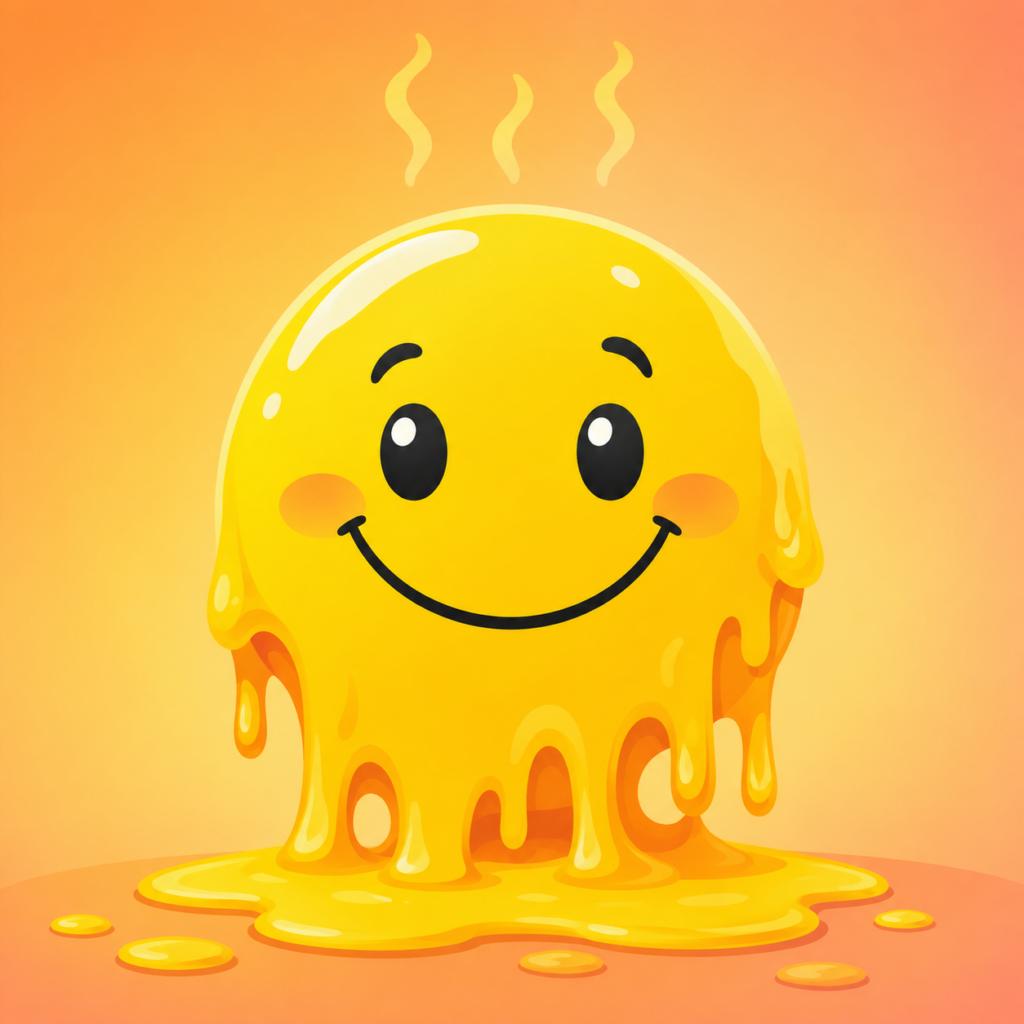
You’re scrolling through a group chat, and someone drops a single 🫠 with no other words. No caption. No explanation. Just a face that looks like it’s slowly dissolving into a puddle.
So, what does the melting face emoji mean? In short, 🫠 is used to express feeling like you’re emotionally or mentally “melting” — usually from embarrassment, awkwardness, stress, being overwhelmed, or secondhand cringe. Sometimes it’s about actual heat, but most of the time, it’s about a feeling that’s a little harder to put into words.
It’s one of those emojis that doesn’t have one single meaning. It shifts depending on who sends it, where they send it, and what the conversation is about. That flexibility is exactly why it’s become so popular — and also why it can be a little confusing if you’re not used to seeing it.
Keep reading, because we’re going to cover every angle: texting, TikTok, Instagram, Snapchat, dating, memes, professional use, similar emojis, generational differences, and a big list of real-life examples so you’ll never be confused by a stray 🫠 again.
Table of Contents
- What Does the Melting Face Emoji Mean?
- The Emotional Meaning Behind 🫠
- When Should You Use the Melting Face Emoji?
- Melting Face Emoji Meaning in Texting
- Melting Face Emoji Meaning on TikTok
- Melting Face Emoji Meaning on Instagram
- Melting Face Emoji Meaning on Snapchat
- Melting Face Emoji Meaning in Dating
- Does the Melting Face Emoji Mean Sadness?
- Different Ways People Interpret 🫠
- Examples of the Melting Face Emoji in Conversations
- Funny Uses of the Melting Face Emoji
- Professional Uses
- Emoji Combinations
- Melting Face Emoji vs Similar Emojis
- Unicode History
- How Different Generations Use 🫠
- Common Mistakes People Make
- Tips for Using the Emoji Naturally
- Copy and Paste
- Frequently Asked Questions
What Does the Melting Face Emoji Mean?
The melting face emoji shows a yellow smiley face that appears to be dripping downward, like it’s turning to liquid. Officially, its Unicode name is simply “Melting Face,” and Emojipedia describes it as conveying feelings of “mental and physical meltdown, dissolving into a puddle from embarrassment or heat,” among other emotions.
In everyday use, though, the meaning is broader and more flexible than the official description suggests. People use 🫠 as a stand-in for a whole cluster of related feelings:
- Extreme embarrassment
- Awkwardness after saying or doing something cringe
- Feeling overwhelmed by too much going on at once
- Burnout or exhaustion
- Sarcastic self-deprecation (“I’m a mess and I know it”)
- Literal heat (“it’s 100 degrees outside”)
- A weird mix of flattery and awkwardness, like after a compliment
That range is exactly why the emoji works so well in texting. It captures a feeling that’s hard to describe in words — that in-between space of “I’m not crying, I’m not laughing, but something is happening to me right now” — in a single small image.
The Emotional Meaning Behind 🫠
At its core, 🫠 is an emotion emoji, not a literal one. Nobody sending it is actually melting. They’re using it as shorthand for an intense or complicated feeling.
Here’s a closer look at the emotions people usually tie to it:
Embarrassment. This is probably the single most common use. Something happened — you tripped, you said the wrong name, you replied-all by accident — and 🫠 captures that “I want to disappear right now” feeling.
Awkwardness. Slightly different from embarrassment, this is more about tension or discomfort in a social moment. Think: running into your ex, an awkward silence on a video call, or a joke that didn’t land.
Burnout and exhaustion. A lot of people, especially students and workers, use 🫠 to describe feeling completely drained. “Finals week 🫠” or “back-to-back meetings all day 🫠” both fit here.
Giving up (in a lighthearted way). Sometimes it’s used almost like a white flag — not a serious one, but a “I can’t deal with this today” kind of surrender.
Emotional overload. When too many things are happening — good or bad — 🫠 can express that sense of being emotionally flooded.
Social anxiety. Some people reach for this emoji specifically in moments of social pressure, like being put on the spot in a meeting or class.
Self-deprecating humor. This is a big one. Instead of typing out “I’m embarrassed,” people use 🫠 to poke fun at themselves in a way that feels light and self-aware rather than heavy.
The common thread across all of these? Intensity. Whatever the specific emotion, 🫠 signals “this feeling is a lot right now” — but usually in a way that’s meant to be relatable or funny rather than genuinely distressing.
When Should You Use the Melting Face Emoji?
Use 🫠 when you want to express embarrassment, awkwardness, overwhelm, or lighthearted defeat without writing a whole sentence about it. It works best attached to a short, relatable statement.
Some realistic examples of when people reach for it:
- “I sent the text to the wrong person 🫠”
- “I forgot my presentation 🫠”
- “Monday morning again 🫠”
- “My internet stopped during the meeting 🫠”
- “I called my teacher ‘mom’ 🫠”
- “I just realized I’ve been on mute for 10 minutes 🫠”
- “It’s 102 degrees outside 🫠”
- “I have three deadlines today 🫠”
- “My crush just liked my story from 3 weeks ago 🫠”
- “I tripped in front of the whole cafeteria 🫠”
Notice the pattern: each of these is a small disaster, a moment of heat (literal or emotional), or a situation that’s a little too relatable. That’s the sweet spot for this emoji.
Melting Face Emoji Meaning in Texting
In texting, 🫠 usually replaces a longer explanation of how flustered, tired, or embarrassed someone feels. It’s efficient — one character instead of a paragraph.
A few common texting scenarios:
- Replying to bad news with just 🫠 instead of “oh no that’s rough”
- Ending a rant about a long day with 🫠 to sum up the exhaustion
- Sending 🫠 after an awkward text you immediately regret
- Using it to react to someone else’s embarrassing story in the chat
Because texting lacks tone of voice, this emoji helps signal “I’m not actually upset, I’m just dramatically reacting” — which keeps things light even when the topic is stressful.
Melting Face Emoji Meaning on TikTok
On TikTok, 🫠 is a staple of comment sections and captions, especially in relatable or self-deprecating content. It shows up under videos about awkward encounters, embarrassing throwbacks, burnout humor, and “why is this literally me” moments.
Gen Z has largely adopted it as a visual punchline. A caption like “when your crush walks past and you trip 🫠” pairs the emoji with a specific, cringe-but-funny scenario — which is the exact meme format that made this emoji so popular in the first place. It’s less about literal sadness and more about shared, relatable humiliation that everyone finds funny because they’ve been there too.
Melting Face Emoji Meaning on Instagram
On Instagram, 🫠 shows up across Stories, comments, and DMs, and the meaning shifts slightly depending on where it lands.
In Stories: Often used as a reaction sticker to something funny, chaotic, or overwhelming — like a friend’s story about a wild day.
In comments: Frequently used to react to someone else’s embarrassing or relatable post, almost like a laughing emoji but with a bit more “I feel your pain” energy.
In DMs: This is where things get more nuanced. A 🫠 sent after a compliment or a flirty message often signals flustered excitement rather than actual distress — more on that in the dating section below.
Melting Face Emoji Meaning on Snapchat
Snapchat conversations tend to be quick, casual, and visual, and 🫠 fits right into that style. It’s commonly used as a caption on a snap showing something chaotic, hot, or embarrassing — a messy room, a sunburn, a terrible hair day, or a screenshot of an awkward conversation.
Because Snapchat leans heavily on humor and self-deprecation between friends, 🫠 often works as a punchline rather than a genuine cry for help. If a friend sends a snap of a burnt dinner with a 🫠 caption, they’re not devastated — they’re laughing at themselves.
Melting Face Emoji Meaning in Dating
Dating apps and flirty texting are where 🫠 gets its most emotionally loaded meaning. Depending on context, it can signal:
After a compliment: “You looked really good today” → “🫠” often means “I’m flustered and flattered and don’t know what else to say.”
While flirting: Used to show that someone’s words are having an effect — a playful way of saying “you’re making me nervous (in a good way).”
After an embarrassing moment: Two people on a date, one spills a drink — a follow-up text with 🫠 says “that was mortifying, but also kind of funny.”
In romantic conversations: Sometimes used when a conversation gets a little too sweet or intense, as a way to say “this is making my heart race and I’m not sure how to respond.”
Is 🫠 flirting on its own? Not necessarily — context matters more than the emoji itself. But paired with a compliment or a flirty comment, it often reads as a positive, slightly shy reaction rather than genuine discomfort.
Does the Melting Face Emoji Mean Sadness?
Not really. While the melting face can look dramatic, it usually represents emotional overwhelm, embarrassment, or exhaustion rather than deep sadness or grief. If someone is genuinely sad, they’re more likely to use 😢, 😭, or 💔.
Think of 🫠 as sitting closer to “I can’t even” than “I’m heartbroken.” It’s expressive and a little theatrical, but it’s typically used in a self-aware, sometimes humorous way — even when the underlying feeling (stress, embarrassment, burnout) is real.
Different Ways People Interpret 🫠
| Situation | Meaning | Example |
|---|---|---|
| Embarrassing mistake | “I want to disappear” | “I called my boss ‘dude’ 🫠” |
| Hot weather | Literal heat | “It’s 100°F today 🫠” |
| Burnout | Total exhaustion | “Third all-nighter this week 🫠” |
| Compliment received | Flattered but flustered | “You’re so talented” → “🫠” |
| Awkward silence | Social discomfort | “The call went silent for 10 seconds 🫠” |
| Overwhelmed schedule | Too much at once | “3 exams tomorrow 🫠” |
| Secondhand cringe | Reacting to someone else’s awkward moment | “She actually said that? 🫠” |
| Giving up (lightly) | Playful surrender | “I’m just going to nap through this 🫠” |
Examples of the Melting Face Emoji in Conversations
- “I just walked into the glass door in front of everyone 🫠”
- “My mic was on the whole meeting 🫠”
- “Group project partner ghosted again 🫠”
- “I said ‘love you too’ to my coworker by accident 🫠”
- “The AC broke and it’s 95 in here 🫠”
- “I have five assignments due tonight 🫠”
- “My phone died mid-interview 🫠”
- “I liked his photo from 2019 by accident 🫠”
- “Autocorrect changed ‘meeting’ to something else 🫠”
- “I forgot her name mid-introduction 🫠”
- “Woke up 45 minutes late for the exam 🫠”
- “My card got declined at the register 🫠”
- “I laughed at the wrong moment in the funeral home 🫠”
- “Texted my ex instead of my mom 🫠”
- “Called my teacher ‘mom’ in front of the class 🫠”
- “Tripped on the stage during graduation 🫠”
- “My stomach growled during the silent test 🫠”
- “Sent a typo-filled email to the whole company 🫠”
- “Got caught talking about someone right as they walked in 🫠”
- “Realized I had spinach in my teeth the entire date 🫠”
Funny Uses of the Melting Face Emoji
Beyond individual mishaps, 🫠 is a meme staple. It’s often paired with exaggerated, relatable captions like “me pretending I understand the group chat inside joke 🫠” or “when the waiter says ‘enjoy’ and I say ‘you too’ 🫠.” The humor comes from the shared recognition — everyone has had that exact “why did I just do that” moment, and the emoji lets people laugh about it together instead of explaining it in detail.
Professional Uses
Can you use 🫠 at work? Sparingly, and only in casual settings. It can work in a relaxed Slack or Teams chat with close coworkers — for example, reacting to a chaotic Monday with “🫠” instead of a full sentence.
When to avoid it:
- In emails to clients or external partners
- In formal reports or official communication
- With supervisors you don’t have a casual relationship with
- In any message where tone could be misread as unprofessional
If you’re unsure, it’s safer to save 🫠 for internal, informal chats and skip it anywhere that needs to read as polished or serious.
Emoji Combinations
- 🫠😂 — Embarrassing but genuinely hilarious.
- 🫠😭 — Overwhelmed to the point of dramatic (often joking) tears.
- 🫠❤️ — Flustered in a good way, often flirty or touched.
- 🫠😅 — Nervous laughter mixed with awkwardness.
- 🫠🥲 — A bittersweet mix of humor and low-key sadness.
- 🫠💀 — “I’m literally dead from embarrassment,” used for maximum dramatic effect.
Melting Face Emoji vs Similar Emojis
| Emoji | Meaning | Emotion | Best Use |
|---|---|---|---|
| 🫠 | Melting/overwhelmed | Embarrassment, overwhelm | Awkward or draining moments |
| 🥲 | Bittersweet smile-cry | Touched, slightly sad | Emotional but positive moments |
| 😅 | Nervous relief | Awkward relief | Narrow escapes, mild embarrassment |
| 😭 | Intense laughing or crying | Strong emotion | Extreme reactions, humor or sadness |
| 😵 | Dizzy, overwhelmed | Confusion, shock | Being stunned or overloaded with info |
| 😵💫 | Spiraling, dazed | Disorientation | Chaotic or confusing situations |
| 😶🌫️ | Foggy, checked out | Numbness, distraction | Zoning out, feeling blank |
| 😳 | Caught off guard | Surprise, flustered | Shock, being called out |
| 😬 | Cringing | Discomfort | Bracing for something bad |
Unicode History
The melting face emoji was approved as part of Unicode 14.0 in September 2021 and became widely available on major platforms throughout 2022. It’s part of a wider set of “abstract emotion” emojis introduced around the same time — designed to capture feelings that don’t map cleanly onto a simple smile or frown.
One interesting detail: unlike most face emojis, 🫠 doesn’t represent a specific, universally agreed-upon emotion in its official Unicode documentation. Emojipedia notes it can represent everything from awkwardness to heat to a general feeling of “melting” under pressure — which is part of why its everyday use has become so broad and community-driven.
How Different Generations Use 🫠
Gen Alpha: Often used in meme captions and comment sections, closely tied to TikTok and Instagram humor, sometimes paired with slang for extra exaggeration.
Gen Z: The heaviest users overall. Applies it to embarrassment, burnout, dating texts, and self-deprecating jokes across nearly every platform.
Millennials: Tends to use it more literally — heat, exhaustion, or a rough day — with slightly less irony than younger users.
Gen X: Uses it more sparingly, often closer to its literal meaning (feeling drained or overwhelmed) rather than as a meme punchline.
Common Mistakes People Make
- Using it in serious emotional conversations where a real feelings check-in is needed (it can come across as dismissive)
- Sending it in formal or client-facing messages
- Assuming it always means sadness, when it’s usually closer to overwhelm or embarrassment
- Overusing it so often that it loses its impact
- Misreading it as always flirtatious in dating contexts, when it’s often just genuine flustered reaction
Tips for Using the Emoji Naturally
- Pair it with a short, specific situation rather than sending it alone with no context (unless the context is already obvious from the conversation)
- Save it for lighter, relatable moments rather than heavy emotional topics
- Match the energy of the conversation — it works best in casual, friendly exchanges
- Don’t overthink it in dating contexts; read the rest of the message, not just the emoji
- Keep it out of professional or formal writing
Copy and Paste
🫠
[Copy Emoji]
Just tap or click the emoji above to copy it, then paste it directly into your texts, captions, or comments. It works across iOS, Android, WhatsApp, Instagram, TikTok, and most modern apps and websites.
Conclusion
So, what does the melting face emoji mean? Most of the time, 🫠 expresses emotional melting — embarrassment, awkwardness, stress, burnout, or humorous self-deprecation — rather than genuine sadness. Its meaning shifts a little depending on where it’s used, whether that’s a group chat, a TikTok comment, an Instagram DM, or a flirty text, but the core idea stays the same: something felt like a lot, and this little melting face said it better than words could.
Next time you’re not sure how to respond to an awkward moment, a stressful day, or a flustering compliment, 🫠 might be exactly the reaction you’re looking for. Just remember to read the context around it — and maybe save it for the casual conversations rather than the formal ones.
You Might Also Like
- What Does the White Heart Emoji Mean
- What Does the Pink Heart Emoji Mean
- What Does the Blue Heart Emoji Mean
Frequently Asked Questions
What does 🫠 mean from a girl? It usually means she’s feeling flustered, embarrassed, or overwhelmed by something in the conversation — often used after a compliment or an awkward moment, and only sometimes flirtatious depending on context.
What does 🫠 mean from a guy? Similar to its general meaning — embarrassment, being flustered, or reacting to something intense or funny. It’s not gender-specific in meaning.
Is 🫠 flirting? Not on its own. In a flirty or complimentary conversation, it can signal being pleasantly flustered, but the surrounding message matters more than the emoji itself.
Does 🫠 mean awkward? Yes, awkwardness is one of its most common meanings, especially in texting and social media comments.
Does 🫠 mean stress? Yes. It’s frequently used to express feeling stressed, overwhelmed, or burned out, especially around deadlines or busy schedules.
Is 🫠 positive or negative? It’s usually neutral-to-lighthearted. Even when describing a rough situation, it tends to carry a joking, self-aware tone rather than a genuinely negative one.
What does 🫠 mean on TikTok? On TikTok, it’s mostly used in relatable, self-deprecating captions and comments about embarrassing or overwhelming moments.
What does 🫠 mean on Snapchat? On Snapchat, it typically captions something chaotic, hot, or embarrassing in a casual, joking way between friends.
When should I use 🫠? Use it when you want to express embarrassment, awkwardness, or feeling overwhelmed in a lighthearted, relatable way — ideally with a short explanation attached.
What emoji is similar to 🫠? 🥲, 😅, and 😵💫 are the closest in tone, each covering slightly different shades of awkwardness, bittersweetness, or disorientation.
Can you use 🫠 at work? Only in casual, informal chats with close coworkers. Avoid it in emails, reports, or client communication.
Does 🫠 mean giving up? Sometimes, but usually in a playful, non-serious way — more “I can’t deal with this today” than an actual sign of distress.
Why is 🫠 so popular? Because it captures a complex, hard-to-describe feeling — a mix of embarrassment, heat, and overwhelm — in one simple image, which makes it perfect for fast, casual digital communication.
Is 🫠 the same as crying? No. Crying emojis like 😭 express sadness or intense laughter, while 🫠 leans more toward overwhelm, awkwardness, or embarrassment.
Does the meaning change by platform? The core meaning stays similar, but tone shifts slightly — more meme-driven on TikTok, more casual on Snapchat, and more nuanced in dating-related DMs on Instagram.