
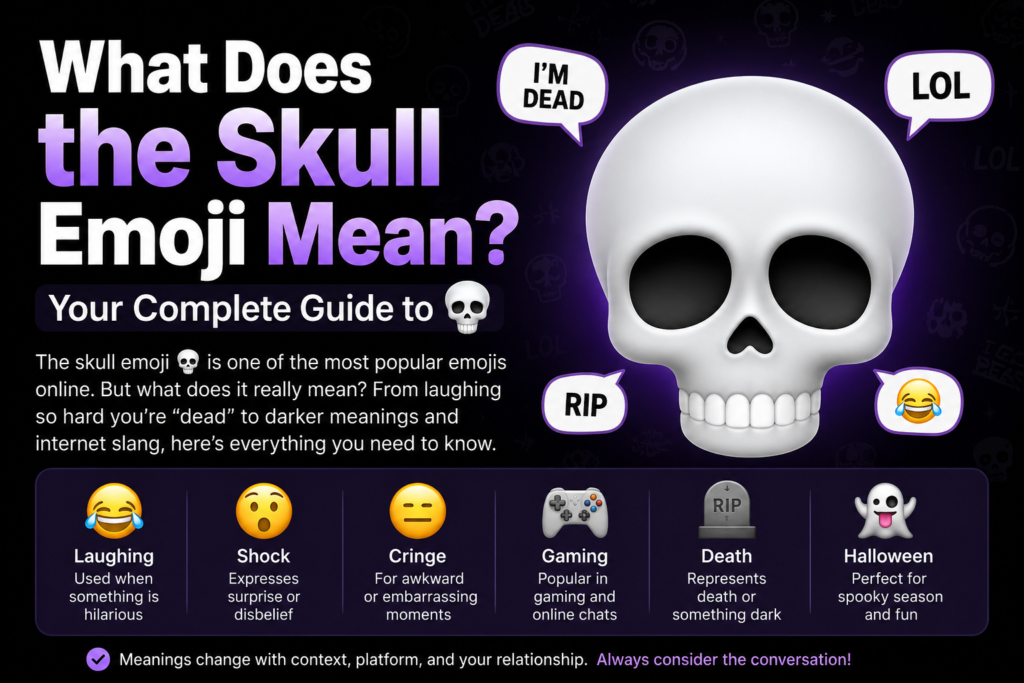
If you’ve spent any time on TikTok, Instagram, or in a group chat lately, you’ve probably seen someone respond to a joke with nothing but a skull emoji. No words, just 💀. And if you’re not chronically online, that can be genuinely confusing. Isn’t a skull supposed to mean something scary, or even morbid?
Here’s the short answer: most of the time, the skull emoji means “I’m dead” from laughing — it’s shorthand for something being so funny it practically killed you. It’s the internet’s dramatic way of saying “I can’t even,” except funnier and quicker to type. But that’s not the only thing it can mean, and figuring out which meaning applies depends a lot on who sent it, where you saw it, and what came before it.
This guide breaks down every common use of 💀, from its literal definition to its slang meaning on TikTok, Snapchat, Discord, and in regular texting. We’ll also cover the technical Unicode details, how to copy it, when you probably shouldn’t use it, and how it compares to its cousin, the skull and crossbones (☠️).
Key Takeaways
- 💀 usually means “I’m dead” — as in, something was so funny or shocking it “killed” the person.
- It’s a huge part of Gen Z slang and meme culture, especially on TikTok.
- The literal meaning (death, mortality, danger) still applies in some contexts, like Halloween posts or gaming.
- Meaning shifts depending on platform, relationship, and tone — a skull from a crush hits differently than one from a coworker.
- It’s generally not appropriate for professional or serious conversations.
Table of Contents
- What Does the Skull Emoji Mean?
- Why Do People Use the 💀 Emoji?
- Skull Emoji Meaning on TikTok
- Skull Emoji Meaning in Text Messages
- What Does the Skull Emoji Mean From a Girl?
- What Does the Skull Emoji Mean From a Guy?
- Skull Emoji Meaning on Snapchat
- Skull Emoji Meaning on Instagram
- Skull Emoji Meaning on Discord
- Skull Emoji vs ☠️ Skull and Crossbones
- Unicode Information
- How to Copy the Skull Emoji
- Common Misunderstandings
- Examples of Using the Skull Emoji
- When You Shouldn’t Use the Skull Emoji
- Related Emojis
- Final Thoughts
- FAQ
What Does the Skull Emoji Mean?
At its most basic, the 💀 emoji is a picture of a human skull. That’s the literal, dictionary-level answer, and it’s what you’ll find if you look up the official Unicode description. Historically and in a lot of contexts, it’s used to represent death, danger, mortality, or something spooky — think pirate flags, poison warnings, or Halloween decorations.
But ask that question to anyone under 30 and you’ll get a completely different answer. In modern internet slang, the skull emoji is used to say “I’m dead,” meaning something was so funny, embarrassing, or unexpected that it figuratively killed the sender. It’s replaced (or at least joined) 😂 as the go-to reaction for genuine laughter online.
Why a skull instead of, say, a laughing face? The logic tracks the phrase “I’m dead” or “this killed me” — sayings people already used before emoji made it visual. A skull is literally what’s left when someone dies, so it became the natural emoji stand-in for that expression. It’s a little morbid if you think about it too hard, but that’s kind of the point — dark humor is baked into how Gen Z communicates online.
So when someone asks “what does 💀 mean,” the honest answer is: it depends on context, but nine times out of ten in a casual chat, it means laughter, not literal death.
Why Do People Use the 💀 Emoji?
The skull emoji covers a surprising amount of emotional ground. Here’s a rundown of the most common reasons people reach for it.
- Laughing so hard I’m dead. This is the big one. Someone sends a meme, a screenshot, or a joke, and the reply is just 💀. It signals genuine, can’t-breathe laughter.
- Embarrassment. Sometimes it’s used after someone shares an awkward or cringeworthy story about themselves — like “I just called my teacher mom 💀.”
- Shock or disbelief. A wild plot twist, an unexpected confession, or a shocking headline can all get the skull treatment, meaning “I can’t believe this.”
- Cringe. When something is so uncomfortable to witness that words fail, 💀 fills in for “yikes.”
- Sarcasm. Sometimes it’s dropped into a sentence to signal that the person doesn’t actually mean what they just said.
- Dark humor. Jokes about bad luck, chaotic situations, or mildly self-destructive decisions often get a skull instead of a laughing emoji, since it fits the tone better.
- Actual death or mortality. Less common in casual chat, but the skull still shows up in its literal sense — obituary posts, true crime content, medical contexts, or serious warnings.
- Halloween and spooky season. Around October, 💀 pops back into its traditional role as a symbol of the macabre, alongside 🎃 and 👻.
- Gaming. In games like Fortnite, Call of Duty, or Minecraft, a skull often marks a death, a kill count, or a “game over” screen.
- Memes. The emoji has become a meme unto itself — entire comment sections sometimes consist of nothing but rows of skulls.
Skull Emoji Meaning on TikTok
If there’s one platform responsible for turning 💀 into a cultural phenomenon, it’s TikTok. Scroll through any viral video’s comment section and you’ll see it everywhere, often stacked in groups like 💀💀💀 for extra emphasis.
On TikTok, the skull emoji is basically the visual version of “I’m dead” or “I can’t.” It shows up under videos that are unexpectedly funny, chaotic, relatable, or absurd. Creators lean into it too — captions like “the way I 💀’d” or “this had me 💀” are extremely common phrasing in that corner of the internet.
Part of why it caught on so hard on TikTok specifically is the app’s meme-driven comment culture. Comments are often judged by how clever or funny they are, and a well-placed skull (sometimes alone, sometimes paired with a quote from the video) reads as an efficient, low-effort-but-high-impact reaction. It’s quicker to type than “I’m crying laughing” and somehow conveys more intensity than 😂 at this point, at least among younger users.
Skull Emoji Meaning in Text Messages
Texting is where things get more nuanced, because unlike a public TikTok comment, a text is personal and the meaning leans heavily on your relationship with the sender.
In most everyday texting, 💀 still points to laughter — someone sends a funny story or a meme link, and you reply with the skull to say “that’s hilarious.” But texting also opens the door to other shades of meaning:
- Used after describing your own mistake, it can mean self-deprecating humor (“I locked myself out again 💀”).
- Used mid-conversation without an obvious joke, it might signal disbelief or secondhand embarrassment about something the other person just said.
- Used repeatedly (💀💀💀), it usually just amplifies whatever emotion is already there — more laughter, more shock, more cringe.
If you’re ever unsure what someone meant by a skull in a text, the safest move is to look at what was said right before it. The emoji rarely stands entirely alone in meaning; it’s reacting to something.
What Does the Skull Emoji Mean From a Girl?
There’s no universal rulebook here, and it’s worth being upfront about that — emoji meaning isn’t gendered in any official sense. But since this is a common search, here’s how it typically plays out.
When a girl sends 💀 in a casual or friendly context, it almost always means the same thing it means for anyone else: something was funny, embarrassing, or shocking. If you just told a joke or shared something ridiculous, that’s likely all it is.
Where people start reading into it more is in flirtier conversations. A skull emoji dropped after a slightly bold or teasing comment can sometimes read as playful, flustered laughter — the texting equivalent of covering your face while giggling. It’s not a confirmed sign of romantic interest on its own, though. Tone, frequency of texting, and what else she’s saying matter far more than one emoji.
What Does the Skull Emoji Mean From a Guy?
Same logic applies in reverse. When a guy sends 💀, it’s overwhelmingly likely to mean genuine amusement — he found something funny, awkward, or wild enough to comment on.
In a flirtier context, it can carry a bit of an “I can’t believe you just said that” energy, especially if it follows a joke that’s a little cheeky or bold. Some guys also use it as a low-effort way to react without writing out a full response, similar to how “lol” gets used as filler acknowledgment.
As with the previous section, don’t overanalyze a single skull emoji in isolation. Context — the conversation’s overall tone, how often you talk, and what was said right before — tells you far more than the emoji by itself ever could.
Skull Emoji Meaning on Snapchat
Snapchat has its own set of emoji with very specific meanings tied to your friendship streaks and interactions — things like 🔥 for streaks or 😎 for mutual best friends. The skull emoji isn’t part of Snapchat’s official emoji ranking system, so it doesn’t carry a Snapchat-specific “status” meaning.
Instead, on Snapchat, 💀 is used the same way it’s used in texting or TikTok comments: as a reaction to something funny, shocking, or cringe in a chat, a caption, or a reply to a Snap. If a friend’s Snap is chaotic or hilarious, a skull reply communicates “I’m dead” just like anywhere else.
Skull Emoji Meaning on Instagram
On Instagram, the skull emoji shows up most often in comment sections under funny reels, memes, or relatable posts. It works the same way it does on TikTok — a quick, low-effort way to signal “this is hilarious” without writing a full comment.
It’s also common in Instagram captions themselves, where creators use it to describe their own reaction to something (“when the wifi cuts out during a work call 💀”). Story replies follow the same pattern — someone posts something funny or embarrassing, and friends reply with a skull instead of typing out “haha.”
Skull Emoji Meaning on Discord
Discord’s culture leans more meme-heavy and community-specific than most platforms, so the skull emoji fits right in. In most servers, it means exactly what it means everywhere else — laughter, disbelief, or “that’s so bad it’s good.”
Where Discord differs slightly is that some servers create custom emoji reactions based on the skull (or similar death-themed icons) to react to messages, rather than typing 💀 directly. The underlying sentiment is the same, though: something was funny, chaotic, or worthy of a dramatic reaction.
Skull Emoji vs ☠️ Skull and Crossbones
These two often get mixed up, but they’re technically different emoji with different Unicode definitions and, in practice, somewhat different vibes.
| Feature | 💀 Skull | ☠️ Skull and Crossbones |
|---|---|---|
| Official Unicode name | Skull | Skull and Crossbones |
| Literal meaning | Death, mortality, a human skull | Danger, poison, piracy warning |
| Common slang use | “I’m dead” from laughing; shock; cringe | Occasionally used for laughter too, but less common |
| Typical context | Casual texting, TikTok, memes, humor | Warning labels, pirate themes, danger, edgier humor |
| Vibe | Playful, meme-heavy | Slightly more serious or edgy |
In casual conversation, most people default to 💀 rather than ☠️ simply because it’s easier to find and has become the established slang symbol. ☠️ still gets used, but it leans a bit more toward danger, warnings, or a harder-edged joke rather than pure “that’s hilarious” energy.
Unicode Information
For anyone curious about the technical side of the skull emoji:
- Unicode version: 6.0 (2010)
- Emoji version: 1.0 (2015)
- Official Unicode name: SKULL
- Codepoint: U+1F480
- HTML entity:
💀 - Copy button example: 💀 (tap or click to copy)
How to Copy the Skull Emoji
Need to grab 💀 quickly? Here’s how on every major device:
Windows: Press Windows key + . (period) or Windows key + ; to open the emoji picker, then search “skull.”
Mac: Press Control + Command + Space to open the emoji viewer, then search “skull.”
Android: Open your keyboard, tap the emoji icon (usually a smiley face), and search “skull” in the search bar.
iPhone: Open the emoji keyboard (tap the globe or smiley icon), then search “skull” using the magnifying glass, or simply copy it from this page: 💀
Common Misunderstandings
There are a few myths worth clearing up about this emoji:
- Myth: It always means someone is upset or being morbid. In reality, it’s almost always positive — a reaction to something funny.
- Myth: It’s the same as the 💯 or 😂 emoji. It’s related in spirit (both signal strong reactions) but carries its own distinct “I’m dead from laughing” tone rather than pure approval or amusement.
- Myth: It’s rude or aggressive. On its own, it’s rarely meant as an insult. It reads as playful, not hostile.
- Myth: Only teenagers use it. While it’s strongly associated with Gen Z, plenty of millennials and even older users have adopted it in casual texting.
- Myth: It means the same thing in every context. As covered throughout this guide, platform, relationship, and surrounding text all shift its meaning.
Examples of Using the Skull Emoji
Here are 20 realistic examples showing how 💀 shows up in everyday digital conversation:
- “he tripped over his own shoelace in front of the whole class 💀”
- “why does my cat judge me like this 💀”
- “I sent that text to the wrong group chat 💀”
- “the way she said ‘no thoughts, head empty’ 💀”
- “my wifi died mid-presentation 💀”
- “bro really said that with a straight face 💀”
- “I forgot my own phone number during the interview 💀”
- “this meme has been living in my head rent free 💀💀”
- “not him showing up in pajamas to a formal event 💀”
- “she really thought that was a good excuse 💀”
- “the plot twist in that show 💀 I did NOT see that coming”
- “my alarm didn’t go off and I woke up at noon 💀”
- “he unironically said that was his best pickup line 💀”
- “the audacity of this raccoon 💀”
- “I just said ‘you too’ when the waiter said enjoy your meal 💀”
When You Shouldn’t Use the Skull Emoji
As versatile as 💀 is, there are situations where it’s a bad fit — or could come across as tone-deaf.
- Professional emails. Emoji in general are risky in formal written communication, and a skull specifically can look unprofessional or confusing to colleagues and clients.
- Workplace chats with people you don’t know well. Even on Slack or Teams, it’s safer to gauge the culture of your specific workplace before dropping slang emoji.
- Serious conversations. If someone is sharing genuinely bad news, grief, or a real problem, using 💀 (even meaning “wow, that’s shocking”) can easily be misread as making light of something painful.
- Sensitive topics involving actual death, illness, or loss. Given its literal meaning, the skull emoji can come across as insensitive here, even if that’s not the intent.
- Conversations with people unfamiliar with the slang. Older relatives, new coworkers, or people from different online cultures may take it literally and assume something’s wrong.
Related Emojis
| Emoji | Name | Meaning | Best Use |
|---|---|---|---|
| ☠️ | Skull and Crossbones | Danger, poison, piracy | Warnings, edgier jokes |
| 😂 | Face with Tears of Joy | Laughing hard | General humor |
| 🤣 | Rolling on the Floor Laughing | Intense laughter | Extremely funny content |
| 😭 | Loudly Crying Face | Crying from laughter or sadness | Emotional reactions, both funny and sad |
| 👻 | Ghost | Spooky, playful haunting | Halloween, lighthearted spooky jokes |
| 🪦 | Headstone | Death, memorial, “this is embarrassing” | Dramatic or joking references to death |
| ⚰️ | Coffin | Death, finality, dramatic emphasis | Serious or joking references to death |
| 😵 | Dizzy Face | Confusion, being overwhelmed | Chaotic or shocking situations |
| 😵💫 | Face with Spiral Eyes | Disorientation, information overload | Overstimulation, confusion |
| 🙃 | Upside-Down Face | Sarcasm, irony, forced positivity | Passive-aggressive or ironic tone |
Final Thoughts
So, what does the skull emoji mean? Technically, it’s a picture of a human skull tied to themes of death and mortality. Practically, in the world of texting, TikTok comments, and group chats, it almost always means “I’m dead” — internet shorthand for something being ridiculously funny, shocking, or cringeworthy.
Like most modern slang, its exact meaning bends depending on the platform, the relationship between the people texting, and the conversation happening around it. A skull from a friend after a funny meme means something completely different from one dropped into a serious conversation. Before reading too much into any single emoji, it helps to zoom out and look at the full context — who sent it, where, and why.
If you’re building out your understanding of emoji slang, it’s worth exploring related guides like heart emoji meanings, the crying emoji meaning, or a broader emoji meanings guide to round out your internet literacy.
FAQ
What does the skull emoji mean? The skull emoji (💀) literally represents a human skull and is tied to themes of death. In modern slang, though, it’s most commonly used to mean “I’m dead” — a dramatic way of saying something was extremely funny, shocking, or embarrassing.
Why do Gen Z use the skull emoji? Gen Z adopted the skull as a stand-in for the phrase “I’m dead” or “this killed me,” phrases already used to describe intense laughter. It fits the platform’s meme culture, offers a quick low-effort reaction, and carries a dark-humor edge that feels distinctly online.
Does the skull emoji mean death? Sometimes, yes — in its literal sense, it can represent death, danger, or mortality, especially around Halloween, in gaming, or in serious posts. In casual texting and social media comments, though, it almost always refers to laughter rather than literal death.
What does 💀 mean on TikTok? On TikTok, 💀 is used in comments and captions to react to something extremely funny or unexpected. It’s essentially the platform’s version of “I can’t” or “I’m crying laughing,” often stacked in multiples for emphasis.
What does 💀 mean in texting? In texts, 💀 typically signals laughter, disbelief, or secondhand embarrassment in response to something just said. The exact meaning depends heavily on what was texted right before it and your relationship with the sender.
Is the skull emoji rude? Generally, no. It’s usually a lighthearted, playful reaction rather than an insult. That said, in serious or sensitive conversations, it can come across as dismissive or inappropriate, so context matters.
Can I use the skull emoji professionally? It’s best avoided in professional emails or formal workplace communication. Even in casual work chats, it’s worth gauging your specific workplace culture before using it, since not everyone will interpret it the same way.
What does the skull emoji mean from a crush? From a crush, it usually still means genuine amusement, but in flirtier exchanges it can read as playful, flustered laughter. It’s not a definitive sign of romantic interest on its own — overall tone and conversation patterns matter more.
What does ☠️ mean compared to 💀? ☠️ (skull and crossbones) leans more toward danger, warnings, or piracy themes, and can carry a slightly edgier tone when used in jokes. 💀 (skull) is the more common choice for everyday “I’m dead from laughing” reactions.
Can the skull emoji have different meanings? Yes, definitely. Its meaning shifts based on platform, the relationship between the people texting, and the surrounding conversation — ranging from laughter and shock to, in rarer cases, its literal association with death.