
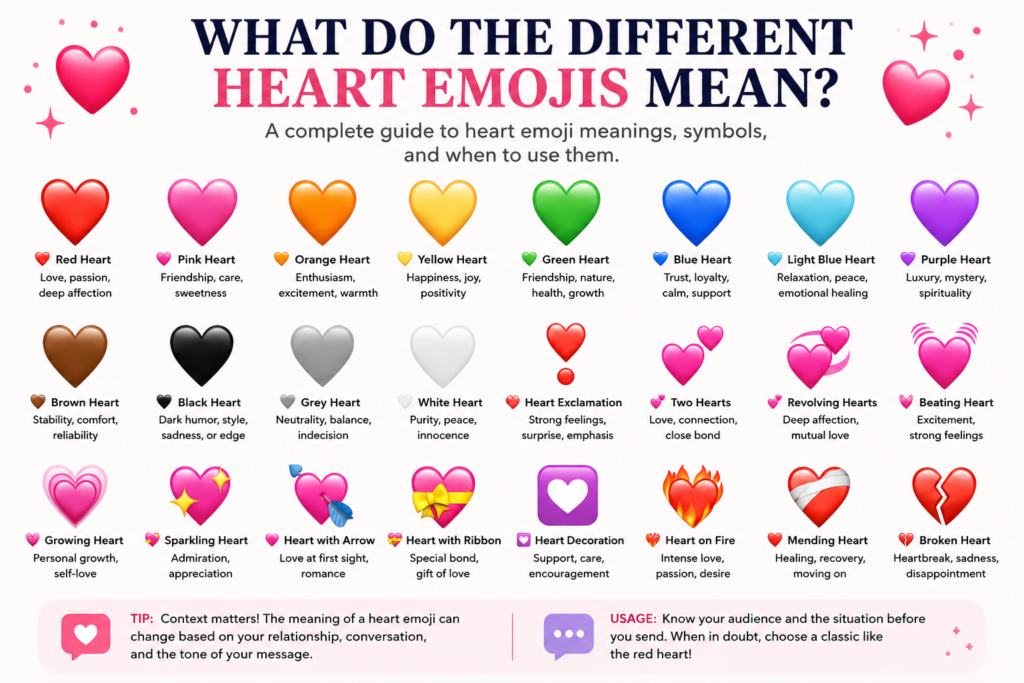
If you’ve ever stared at your keyboard trying to figure out whether to send a green heart or a purple one, you’re not alone. So, what do the different heart emojis mean? In short: every heart color and style carries its own emotional shade, from romantic red to platonic green to the more mysterious black and grey hearts that people use for everything from gothic style to dry humor. There isn’t one universal “love emoji” — there’s a whole language hiding in that row of colored hearts on your keyboard, and picking the wrong one can genuinely change how your message lands.
I’ve spent a lot of time (probably too much) watching how people actually use these emojis in real conversations — texts, Instagram captions, TikTok comments, group chats — and the gap between what people think a heart emoji means and how it’s actually used is bigger than you’d expect. This guide breaks down every heart emoji currently available, explains the reasoning behind each one, and gives you real examples so you’re not left guessing next time you’re typing a message to your mom versus your partner versus your work Slack channel (please don’t send your boss a sparkling heart).
Let’s get into it.
What Do the Different Heart Emojis Mean? A Quick Overview
Before we go emoji by emoji, here’s the big picture. Heart emojis roughly fall into three categories:
- Color hearts (❤️ 🩷 🧡 💛 💚 💙 🩵 💜 🤎 🖤 🩶 🤍) — these are solid, single-color hearts. Their meaning is shaped almost entirely by color psychology and internet convention.
- Shape and motion hearts (💕 💞 💓 💗 💖 💘 💝 💟) — these use movement, sparkles, arrows, or ribbons to add extra emotional intensity or a specific context, like a crush or a gift.
- Situational hearts (❣️ ❤️🔥 ❤️🩹 💔) — these describe a state of the heart itself: exclaiming, on fire, healing, or broken.
Color is doing most of the heavy lifting here. Red still dominates as the default “I love you,” but the newer additions — pink, light blue, and grey — have given people a lot more precision. You can now say “I care about you platonically” (green), “I’m feeling nostalgic and soft” (pink), or “I’m being sarcastic about how sad this is” (black) without typing a single extra word.
Now, let’s break down every single one.
Complete Heart Emoji Meanings
❤️ Red Heart
Meaning: The original. Red heart is the universal symbol for deep love, romance, and passion, though it’s flexible enough to mean strong platonic affection too.
Emotional tone: Intense, sincere, classic.
When people use it: Declaring love, wishing someone a happy anniversary, reacting to something genuinely moving, or just showing enthusiastic support for a friend’s post.
Examples:
- “I love you so much ❤️”
- “Happy 5 years to us ❤️”
- “This photo of your dog made my whole day ❤️”
Text message example: “Missed you today ❤️”
Social media example: A caption on an engagement photo reading “He asked, I said yes ❤️”
Things to avoid: Sending it to a coworker or casual acquaintance, where it can read as overly intimate.
Best alternatives: 🧡 or 💛 for warmth without the romantic weight, or 💚 for platonic care.
🩷 Pink Heart
Meaning: A softer, more playful cousin of red. Pink heart leans toward affection, cuteness, and gentle warmth rather than full-blown romantic intensity.
Emotional tone: Sweet, tender, a little whimsical.
When people use it: Complimenting a friend, reacting to something adorable, or expressing a crush that isn’t quite “I love you” territory yet.
Examples:
- “You’re so sweet 🩷”
- “Obsessed with this outfit 🩷”
Text message example: “Just thinking about you 🩷”
Social media example: Comment under a baby photo: “The cutest thing I’ve ever seen 🩷”
Things to avoid: Using it in formal or professional contexts — it reads as distinctly casual and youthful.
Best alternatives: 🤍 for something gentler, ❤️ if you want more intensity.
🧡 Orange Heart
Meaning: Warmth, friendship, encouragement, and gratitude. Orange sits comfortably between the romance of red and the platonic ease of yellow.
Emotional tone: Encouraging, cozy, appreciative.
When people use it: Cheering someone on, thanking a friend, or expressing enthusiasm without romantic undertones.
Examples:
- “So proud of you 🧡”
- “Thanks for always having my back 🧡”
Text message example: “You always know how to make me laugh 🧡”
Social media example: “Grateful for this friendship every single day 🧡”
Things to avoid: Don’t assume it reads as romantic — if that’s your intent, red communicates it more clearly.
Best alternatives: 💛 for friendship, ❤️ for romance.
💛 Yellow Heart
Meaning: Friendship and happiness. Yellow heart has long been the unofficial “just friends” heart, especially on Snapchat, where it literally denotes your #1 best friend.
Emotional tone: Cheerful, platonic, sunny.
When people use it: Celebrating a friendship, wishing someone joy, or reacting to something wholesome.
Examples:
- “Best friends forever 💛”
- “So happy for you!! 💛”
Text message example: “You’re the best, thank you 💛”
Social media example: A caption tagging a best friend: “10 years of friendship and counting 💛”
Things to avoid: Using it romantically — most people will read it as strictly platonic.
Best alternatives: 🧡 for a slightly warmer platonic tone, 🤍 for simplicity.
💚 Green Heart
Meaning: Nature, growth, health, and platonic love — though as we’ll get into below, it has a few other layers too, including jealousy and environmental causes.
Emotional tone: Fresh, grounded, wholesome.
When people use it: Talking about nature, wellness, sustainability, or close friendships.
Examples:
- “Feeling so grateful for my health 💚”
- “Earth Day reminder to protect our planet 💚”
Text message example: “So glad we’re friends 💚”
Social media example: Caption on a hiking photo: “Nothing beats fresh air 💚”
Things to avoid: Using it to express romantic jealousy sarcastically without context — it can be misread.
Best alternatives: 💛 for friendship, 🌿 emoji if you want to be extra clear about the nature angle.
💙 Blue Heart
Meaning: Trust, loyalty, calm, and platonic or supportive love. Also widely used to show solidarity with causes associated with the color blue, like autism awareness.
Emotional tone: Steady, dependable, cool-headed.
When people use it: Supporting a friend through something hard, showing loyalty, or expressing calm affection.
Examples:
- “Here for you no matter what 💙”
- “So proud to call you my brother 💙”
Text message example: “Take your time, I’m not going anywhere 💙”
Social media example: “Forever grateful for this friendship 💙”
Things to avoid: Don’t confuse it with sadness — despite “feeling blue,” the emoji itself doesn’t read as sorrowful.
Best alternatives: 🩵 for something lighter and more casual.
🩵 Light Blue Heart
Meaning: One of the newer additions, this heart carries a softer, more casual feel than the darker blue heart — often tied to calmness, sincerity, and gentle support.
Emotional tone: Light, breezy, genuine.
When people use it: Reacting to something comforting, or expressing quiet, sincere appreciation.
Examples:
- “Thank you for listening 🩵”
- “This made my day so much better 🩵”
Text message example: “You always know what to say 🩵”
Social media example: Comment on a calming sunset photo: “This is exactly what I needed to see 🩵”
Things to avoid: Overusing it interchangeably with 💙 — they read slightly differently, with light blue feeling gentler and less formal.
Best alternatives: 💙 for a more grounded, loyal tone.
💜 Purple Heart
Meaning: Compassion, understanding, and support — also strongly associated with specific fandoms (BTS’s ARMY famously uses it) and with mental health and disability awareness.
Emotional tone: Empathetic, artistic, a little mysterious.
When people use it: Expressing deep understanding, supporting a cause, or showing fandom loyalty.
Examples:
- “Sending you all my love 💜”
- “ARMY forever 💜”
Text message example: “I understand, take all the time you need 💜”
Social media example: “Mental health awareness month — check on your friends 💜”
Things to avoid: Assuming everyone will catch the fandom reference — context matters.
Best alternatives: 💙 for a more general show of support.
🤎 Brown Heart
Meaning: Stability, groundedness, and — significantly — a symbol of solidarity within Black communities and racial representation. Also just a warm, earthy expression of affection.
Emotional tone: Warm, steady, sincere.
When people use it: Showing love within a specific cultural or community context, or expressing simple, unpretentious affection.
Examples:
- “Proud of who I am 🤎”
- “Love you to pieces 🤎”
Text message example: “So glad you’re in my life 🤎”
Social media example: “Representation matters 🤎”
Things to avoid: Using it without understanding its cultural significance in some contexts.
Best alternatives: ❤️ for general affection without the specific cultural connotation.
🖤 Black Heart
Meaning: Complicated by design. Black heart can mean dark humor, gothic aesthetic, sarcasm, sadness, or emotional detachment depending entirely on context — more on this in its own section below.
Emotional tone: Edgy, ironic, sometimes melancholic.
When people use it: Dark jokes, aesthetic captions, expressing grief, or being intentionally vague about feelings.
Examples:
- “Life is chaos 🖤”
- “Simple pleasures only 🖤”
Text message example: “Not okay but we move 🖤”
Social media example: Caption on an all-black outfit photo: “Mood 🖤”
Things to avoid: Using it as a genuine “I love you” — it rarely reads that way and can confuse a romantic partner.
Best alternatives: ❤️ if you actually mean romantic love.
🩶 Grey Heart
Meaning: One of the rarest and newest hearts. Grey heart tends to express quiet, understated affection — a kind of “it’s complicated” or subdued emotional tone that doesn’t fit neatly into the brighter colors.
Emotional tone: Muted, reflective, neutral.
When people use it: Expressing something bittersweet, or simply liking the aesthetic on a neutral-toned post.
Examples:
- “It’s been a weird week 🩶”
- “Simple and stormy 🩶”
Text message example: “Not sure how I feel about this one 🩶”
Social media example: Caption on a rainy-day photo: “Some days just feel like this 🩶”
Things to avoid: Expecting most people to immediately recognize it — it’s still one of the least understood hearts.
Best alternatives: 🖤 for a stronger emotional statement.
🤍 White Heart
Meaning: Purity, sincerity, new beginnings, and calm. White heart is often used for minimalist aesthetics as well as genuine, uncomplicated affection.
Emotional tone: Clean, peaceful, sincere.
When people use it: Weddings, new beginnings, minimalist captions, or simple heartfelt support.
Examples:
- “New chapter starts now 🤍”
- “So much love for you both 🤍”
Text message example: “Wishing you peace today 🤍”
Social media example: Wedding caption: “Forever starts here 🤍”
Things to avoid: Don’t use it if you want a strong emotional statement — it reads as gentle, not intense.
Best alternatives: 🩶 for something slightly more subdued, ❤️ for more intensity.
❣️ Heart Exclamation
Meaning: An emphatic, energetic version of a heart, used to punctuate excitement or strong feeling much like an exclamation point does with words.
Emotional tone: Excited, urgent, emphatic.
When people use it: Adding punch to a message, especially in celebratory or dramatic moments.
Examples:
- “I can’t believe it, we did it ❣️”
- “Miss you so much ❣️”
Text message example: “Can’t wait to see you tonight ❣️”
Social media example: “This community means everything to me ❣️”
Things to avoid: Overusing it in casual, low-stakes messages — it’s built for emphasis.
Best alternatives: ❤️ for a calmer version of the same sentiment.
💕 Two Hearts
Meaning: Mutual affection between two people — friendship or romance where the feeling is shared and growing.
Emotional tone: Warm, mutual, affectionate.
When people use it: Talking about a close friendship or relationship where both sides clearly care.
Examples:
- “Us against the world 💕”
- “So happy we’re friends 💕”
Text message example: “Can’t stop smiling thinking about today 💕”
Social media example: Caption tagging a best friend: “My person 💕”
Things to avoid: Using it for one-sided feelings — it implies mutuality.
Best alternatives: ❤️ for a single-sided statement of love.
💞 Revolving Hearts
Meaning: Hearts orbiting each other, symbolizing a growing, ongoing, or blossoming romantic connection.
Emotional tone: Dynamic, hopeful, romantic.
When people use it: New relationships, or describing love that’s actively developing.
Examples:
- “Falling for you more every day 💞”
- “This feels different, in the best way 💞”
Text message example: “I really like where this is going 💞”
Social media example: “New beginnings 💞”
Things to avoid: Using it for established, long-term relationships — it implies motion and growth more than stability.
Best alternatives: 💕 for mutual, settled affection.
💓 Beating Heart
Meaning: A racing heartbeat — nervous excitement, anticipation, or a crush.
Emotional tone: Nervous, excited, fluttery.
When people use it: Describing butterflies, anticipation, or an adrenaline-filled moment.
Examples:
- “My heart is racing 💓”
- “So nervous for tomorrow 💓”
Text message example: “I can’t stop thinking about our conversation 💓”
Social media example: “First date jitters 💓”
Things to avoid: Using it for calm, settled feelings — it specifically implies a racing pulse.
Best alternatives: 💗 for a softer version of nervous excitement.
💗 Growing Heart
Meaning: Feelings that are increasing over time — love, gratitude, or affection that keeps building.
Emotional tone: Tender, expanding, sincere.
When people use it: Describing love that deepens, or gratitude that grows the more you think about it.
Examples:
- “I love you more every single day 💗”
- “So thankful, more than words can say 💗”
Text message example: “My feelings for you just keep growing 💗”
Social media example: “Watching my kids grow up is the best part of my life 💗”
Things to avoid: Using it for a one-time, static emotion — it implies progression.
Best alternatives: 💓 for a more nervous, immediate feeling.
💖 Sparkling Heart
Meaning: Excitement, admiration, and a bit of magic — often used to describe something that feels special or dazzling.
Emotional tone: Joyful, glowing, enthusiastic.
When people use it: Complimenting someone, celebrating good news, or expressing genuine delight.
Examples:
- “You look absolutely stunning 💖”
- “This is the best news ever 💖”
Text message example: “So proud of everything you’ve achieved 💖”
Social media example: “Living my best life right now 💖”
Things to avoid: Using it in serious or somber conversations — its tone is distinctly bright.
Best alternatives: ✨❤️ combo if you want the same energy with more emphasis.
💘 Heart with Arrow
Meaning: Cupid’s arrow — falling in love, being struck by a crush, or romantic pursuit.
Emotional tone: Playful, romantic, a little cheeky.
When people use it: New crushes, flirty texts, or Valentine’s Day content.
Examples:
- “Struck right through the heart 💘”
- “You got me 💘”
Text message example: “I think you might have hit me with Cupid’s arrow 💘”
Social media example: Valentine’s Day post: “Be mine 💘”
Things to avoid: Using it for platonic relationships — it’s unambiguously romantic.
Best alternatives: 💞 for a less playful, more sincere version of new romance.
💝 Heart with Ribbon
Meaning: A heart presented as a gift — love, appreciation, or a thoughtful gesture, often tied to gift-giving occasions.
Emotional tone: Generous, thoughtful, celebratory.
When people use it: Birthdays, holidays, or thanking someone for a gift or kind gesture.
Examples:
- “Best gift ever, thank you 💝”
- “Wrapped up with love, just for you 💝”
Text message example: “Got you something special, can’t wait for you to see it 💝”
Social media example: “Thank you all for the birthday love 💝”
Things to avoid: Using it outside gift-related or celebratory contexts — it can feel out of place.
Best alternatives: 🎁❤️ combo for extra clarity.
💟 Heart Decoration
Meaning: A stylized, ornamental heart, often used more for visual decoration than deep emotional meaning.
Emotional tone: Neutral, decorative, playful.
When people use it: Styling a caption or message rather than making a strong emotional statement.
Examples:
- “New post is up 💟”
- “Check out my latest look 💟”
Text message example: “Just sending some good vibes your way 💟”
Social media example: “Link in bio 💟”
Things to avoid: Expecting it to carry strong romantic or emotional weight — it rarely does.
Best alternatives: 🤍 for a similarly light, decorative touch with slightly more warmth.
❤️🔥 Heart on Fire
Meaning: Passionate, intense love or desire — also used more broadly for burning enthusiasm about anything, romantic or not.
Emotional tone: Intense, passionate, high-energy.
When people use it: Describing strong attraction, or hype around something you’re extremely excited about.
Examples:
- “This song is everything ❤️🔥”
- “Can’t stop thinking about you ❤️🔥”
Text message example: “You’re all I can think about ❤️🔥”
Social media example: “This performance was unreal ❤️🔥”
Things to avoid: Using it casually with someone you’re not close to — it reads as intense.
Best alternatives: 💘 for a lighter, more playful version of the same idea.
❤️🩹 Mending Heart
Meaning: A heart in the process of healing — used for emotional recovery, resilience, or acknowledging you’ve been through something hard but are getting better.
Emotional tone: Vulnerable, hopeful, resilient.
When people use it: Talking about recovery from heartbreak, grief, or a hard season of life.
Examples:
- “Slowly getting there ❤️🩹”
- “Healing isn’t linear, but I’m trying ❤️🩹”
Text message example: “Today was a little easier than yesterday ❤️🩹”
Social media example: “One year post-breakup and finally feeling like myself again ❤️🩹”
Things to avoid: Using it flippantly for minor inconveniences — it’s meant for genuine emotional healing.
Best alternatives: 💔 if the wound still feels fresh rather than healing.
💔 Broken Heart
Meaning: Heartbreak, loss, disappointment, or grief — one of the most universally understood emojis on this list.
Emotional tone: Sad, hurt, sometimes dramatic.
When people use it: Breakups, disappointing news, or expressing sympathy for someone else’s loss.
Examples:
- “I can’t believe this happened 💔”
- “So sorry for your loss 💔”
Text message example: “This news really hurt 💔”
Social media example: “Rest easy, you’ll be missed 💔”
Things to avoid: Using it sarcastically without clear context — it can be mistaken for genuine distress.
Best alternatives: ❤️🩹 once you’ve moved from the initial pain into healing.
Green Heart Emoji Meaning
The 💚 green heart emoji deserves its own spotlight because it carries more range than people expect.
Friendship: Green is one of the most common platonic hearts, often used between close friends who want to express love without any romantic implication.
Nature: Because of its color, green heart is the go-to emoji for anything outdoorsy — hiking captions, gardening posts, or general appreciation for the natural world.
Health: People frequently use it when talking about physical or mental wellness, recovery, or gratitude for good health.
Jealousy: Thanks to the old idiom “green with envy,” green heart occasionally shows up in a joking, jealous context — “okay but I’m a little jealous 💚” — though this usage is less common and depends heavily on tone.
Environmental awareness: Green heart is widely used in climate and sustainability content, from Earth Day posts to eco-conscious brand messaging.
Common misunderstandings: The biggest mix-up is assuming green heart is romantic. Most native emoji users read it as platonic first, so if you’re trying to signal romantic interest, red or pink will get the message across more clearly.
Black Heart Emoji Meaning
The 🖤 black heart emoji is probably the most misread heart of the bunch, mostly because it genuinely does mean different things depending on who’s using it.
Dark humor: Often paired with jokes about chaos, exhaustion, or mild suffering — a way of laughing at something rather than being genuinely upset.
Gothic aesthetic: Strongly tied to alternative, gothic, or edgy personal branding, especially in fashion and music-related content.
Sadness: Sometimes used sincerely to express grief or a low mood, particularly among younger users who find brighter hearts feel dishonest when they’re not doing well.
Sarcasm: A dry, deadpan way of reacting to something ironic or absurd — closer to “lol okay” than genuine affection.
Emotional detachment: Occasionally used to signal indifference or emotional distance, almost the opposite of what a heart traditionally represents.
Fashion: Frequently appears in captions about all-black outfits or minimalist style.
Halloween: A seasonal favorite for spooky-themed posts and costumes.
Internet culture: Because it’s so versatile, black heart has become a kind of inside joke across platforms — people often use it precisely because it doesn’t commit to a single clear emotion.
Heart Emoji Color Comparison Table
| Emoji | Meaning | Emotion | Best Use | Avoid When |
|---|---|---|---|---|
| ❤️ | Deep love, romance | Passionate | Romantic messages, big declarations | Casual or professional chats |
| 🩷 | Sweet affection | Tender | Compliments, crushes | Formal settings |
| 🧡 | Warmth, gratitude | Encouraging | Thanking friends | Romantic contexts |
| 💛 | Friendship, happiness | Cheerful | Best friend messages | Romantic declarations |
| 💚 | Nature, platonic love | Grounded | Friendship, health, environment | Trying to signal romance |
| 💙 | Trust, loyalty | Calm | Supporting a friend | Expressing sadness |
| 🩵 | Gentle sincerity | Light | Casual heartfelt support | Serious emotional topics |
| 💜 | Compassion, fandom | Empathetic | Support, fandom love | Contexts needing clarity |
| 🤎 | Stability, solidarity | Warm | Cultural pride, steady affection | Without cultural awareness |
| 🖤 | Dark humor, sadness | Ambiguous | Jokes, aesthetic captions | Genuine romantic messages |
| 🩶 | Quiet, understated | Muted | Reflective posts | Expecting instant recognition |
| 🤍 | Purity, new beginnings | Peaceful | Weddings, fresh starts | Wanting strong intensity |
| ❣️ | Emphatic love | Urgent | Excited, dramatic moments | Low-key casual chats |
| 💕 | Mutual affection | Warm | Close friendships, couples | One-sided feelings |
| 💞 | Growing romance | Hopeful | New relationships | Long-settled relationships |
| 💓 | Racing heart | Nervous | Crushes, anticipation | Calm, settled emotions |
| 💗 | Increasing love | Tender | Deepening feelings | Static, one-time emotion |
| 💖 | Excitement, admiration | Joyful | Compliments, good news | Somber conversations |
| 💘 | Falling in love | Playful | Flirting, Valentine’s Day | Platonic relationships |
| 💝 | Gift of love | Generous | Birthdays, gifts | Non-gift contexts |
| 💟 | Decoration | Neutral | Stylized captions | Serious emotional statements |
| ❤️🔥 | Passionate desire | Intense | Strong attraction, hype | Casual acquaintances |
| ❤️🩹 | Healing | Hopeful | Emotional recovery | Fresh, unprocessed pain |
| 💔 | Heartbreak | Sad | Breakups, sympathy | Sarcasm without context |
Which Heart Emoji Should You Use?
Here’s a quick cheat sheet for common situations:
- Friends: 💛 or 💚 for a clear platonic message.
- Family: ❤️ or 🧡 for warmth without romantic connotation.
- Partner: ❤️, 💞, or ❤️🔥 depending on how intense you want to sound.
- Wedding: 🤍 for purity and new beginnings, or ❤️ for classic romance.
- Birthday: 💝 to tie in the gift-giving spirit.
- Apology: 🩶 or 🤍 — something gentle and non-dramatic.
- Sympathy: 💔 or 🩶, both of which convey sensitivity without overstatement.
- Business: Honestly, skip hearts altogether in most professional contexts. If you must, 🤍 is the safest.
- Social media generally: ✨❤️ or 💛 depending on tone.
- Instagram: 🩷 and 💛 perform well for lifestyle and friendship content.
- TikTok: 🖤 and 💗 are common for aesthetic or emotionally expressive captions.
- WhatsApp: ❤️ remains the default for most personal chats.
Heart Emoji Meanings on Different Platforms
Here’s where things get a little technical, but it matters: the same heart emoji can look slightly different — sometimes meaningfully different — depending on the platform.
Apple: Apple’s heart emojis tend to render with a slightly glossy, rounded design. The color palette is fairly true to the standard Unicode intent.
Google: Android’s Google-designed hearts are flatter and a touch more saturated, though the meanings stay consistent with Apple’s versions.
Samsung: Samsung’s older emoji sets historically diverged more from the Unicode standard, though recent updates have brought them closer in line with Apple and Google.
Microsoft: Microsoft’s emoji designs, used in Windows and Outlook, have shifted toward a more 3D, glossy style in recent years, matching most other platforms’ color choices closely.
WhatsApp: WhatsApp uses its own emoji set, which is generally close to Apple’s rendering, though slightly flatter in style.
Facebook: Facebook’s emoji set has its own distinct look, often described as slightly more cartoonish, but the underlying meanings of each heart remain the same.
Instagram: Instagram pulls from the device’s native emoji set (Apple or Google, depending on your phone), so there’s no separate Instagram-specific heart style.
The takeaway: the meaning of each heart color is standardized by the Unicode Consortium, so while the exact shade or shine might shift slightly between platforms, what you’re communicating stays consistent.
Common Mistakes People Make
- Assuming every heart is romantic. Most heart colors are actually platonic or situational by default.
- Using 🖤 to mean love. It’s far more likely to be read as dark humor or sadness.
- Sending 💘 or 💞 in a platonic context. These are unmistakably romantic and can cause confusion.
- Overloading a message with too many hearts. Five hearts don’t communicate five times the feeling — it usually just reads as excessive.
- Ignoring cultural context. Some hearts, like 🤎, carry specific cultural weight that’s worth understanding before using casually.
- Using hearts in professional emails. Even a friendly ❤️ can feel unprofessional in the wrong workplace context.
Fun Facts About Heart Emojis
- The red heart ❤️ was one of the original emojis included in the very first Unicode emoji set back in 2010.
- Green, blue, and other color hearts weren’t added until years later, gradually expanding the emotional vocabulary available to texters.
- Grey heart 🩶, light blue heart 🩵, and pink heart 🩷 are among the newest additions, introduced as part of more recent Unicode updates.
- Snapchat’s “Best Friends” emoji system, which uses yellow and red hearts to signal friendship rank, is one of the most famous non-Unicode uses of heart emojis in a specific app context.
- ❤️🔥 and ❤️🩹 are technically “ZWJ sequences” — combinations of multiple emoji characters joined together, rather than single standalone symbols.
- Black heart 🖤 usage spiked heavily among younger users on TikTok as a way to express complicated emotions without sounding overly dramatic.
Conclusion
At the end of the day, understanding what the different heart emojis mean comes down to reading the room — who you’re talking to, what you’re trying to say, and how intense you want that feeling to land. Red will always be the safest bet for romance, green and yellow cover friendship well, and black gives you room for humor or complexity when a straightforward heart just doesn’t fit. The more you pay attention to how these emojis actually get used in real conversations, the easier it becomes to pick the right one without a second thought.
If you’re curious about other emoji meanings — from hand gestures to food emojis to the ever-confusing skull emoji — there’s a lot more to explore.
Frequently Asked Questions
What do the different heart emojis mean? Each heart color and style carries a distinct meaning, ranging from romantic (red, pink) to platonic (yellow, green) to situational (broken, healing, on fire). Context and relationship matter just as much as the emoji itself.
What does the green heart emoji mean? Green heart typically represents friendship, nature, health, or environmental causes, and is generally read as platonic rather than romantic.
What does the black heart emoji mean? Black heart is versatile — it can express dark humor, sadness, gothic aesthetic, or sarcasm, depending on the tone of the conversation.
Which heart emoji means love? The red heart ❤️ is the most universally understood symbol for romantic love.
Which heart emoji means friendship? Yellow heart 💛 and green heart 💚 are the most commonly used hearts for platonic friendship.
What is the rarest heart emoji? Grey heart 🩶 is currently one of the least commonly used and least recognized hearts, since it was only recently added.
Can I use a black heart for love? It’s possible, but risky — most people won’t immediately read it as romantic, so red or pink communicates the sentiment more reliably.
What does the white heart symbolize? White heart represents purity, calm, and new beginnings, making it popular for weddings and fresh starts.
What is the difference between 💕 and ❤️? 💕 implies mutual, shared affection between two people, while ❤️ is a more general, one-directional statement of love.
Which heart emoji is best for family? Red ❤️ or orange 🧡 both work well, offering warmth without strictly romantic connotations.
What does ❤️🔥 mean? Heart on fire represents intense passion or desire, and is also used more broadly to express strong enthusiasm about anything.
Which heart emoji should I use on Instagram? Pink 🩷 and yellow 💛 tend to perform well for lifestyle and friendship-focused captions, while red ❤️ remains a safe, universal choice.
Explore more emoji meanings on EmojiVista.